Visual inspection and line monitoring,at production speed.
Reduce human error, automate quality checks, and improve real-time visibility with computer vision systems designed for real manufacturing conditions.
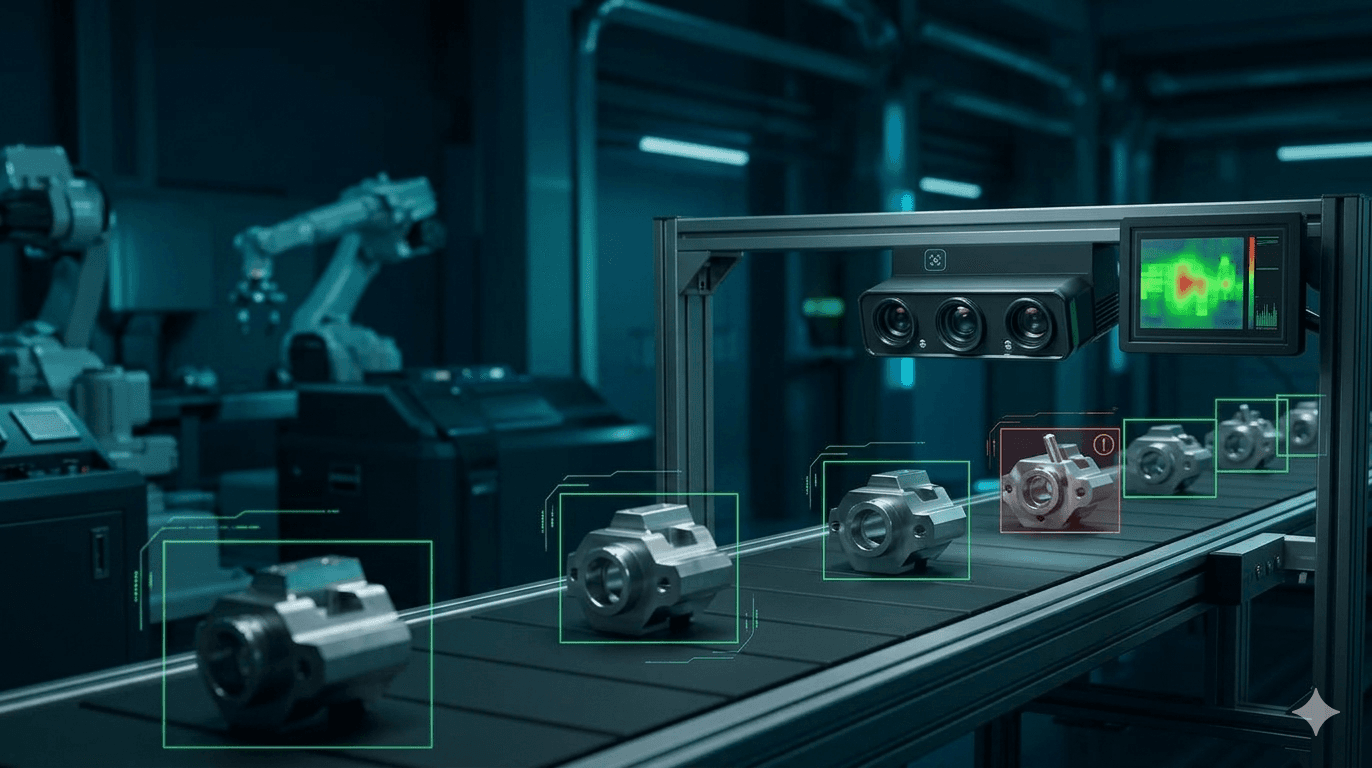
Yield
99.2%
Review
03
Surface anomaly
Irregular condition detected on active line flow
Common production pain points
Manufacturing teams often deal with the same operational blind spots
Manual checks, inconsistent quality control, delayed visibility, and counting issues create production drag. These problems are specific, measurable, and expensive on real lines.
Manual checks break at line speed
Operators and quality teams cannot manually inspect every unit with the same consistency across long shifts, fast cycle times, and changing product formats.
Human error creates uneven outcomes
Even strong teams miss defects, miscounts, or process deviations when checks depend on attention, repetition, and subjective judgment.
Quality control becomes inconsistent
Different stations, shifts, or operators can apply checks differently, which creates variation in quality assurance and more rework downstream.
Real-time visibility is often limited
Many production lines still rely on delayed reporting, manual logs, or partial sampling, which slows issue detection and root-cause analysis.
Counting and tracking are fragile
Product counting, pack verification, and flow tracking can become unreliable when environments are noisy, product formats change, or manual methods creep in.
Waste and rework rise quietly
Defects caught late, inconsistent counting, or missed anomalies create waste, rework, and avoidable performance loss across the line.
How computer vision helps
Turn visual checks into reliable production signals
The value comes from solving practical production tasks. Detect defects earlier. Count products more reliably. Monitor line behavior in real time. Give operators and quality teams better visibility where manual processes fall short.
Automated defect detection
Detect visual defects earlier so quality issues do not move unnoticed through production.
Product counting and tracking
Track products, packs, or units in motion to improve counting accuracy and production visibility.
Production monitoring
Monitor line activity in real time to surface deviations, stoppages, and anomalies earlier.
Operator assistance
Support teams with visual checks, review cues, and better signals at the point of operation.
Quality assurance automation
Automate repetitive inspection steps so quality control becomes more consistent and less dependent on manual review.
Anomaly detection
Identify unusual behavior on the line before it becomes a larger quality or throughput problem.
Practical use cases
Concrete ways computer vision supports manufacturing operations
Defect detection
Detect surface defects, missing components, damaged packaging, or visible process errors earlier in the flow.
Fill level inspection
Check fill consistency and detect underfill or overfill issues on beverage and packaging lines.
Counting and tracking
Automate product counting using computer vision and improve traceability through stations, batches, or packaging steps.
Packaging verification
Verify labels, seals, pack composition, or packaging conformity before products move downstream.
Assembly verification
Confirm parts, orientations, and assembly steps to reduce missed errors and downstream quality escapes.
Production monitoring
Use computer vision for production monitoring to detect anomalies, line deviations, and process interruptions in real time.
Benefits and ROI
Business value that matters on the line
How it works
Start focused, validate value, then scale if it makes sense
01
Identify the right use case
Start with a focused production problem where computer vision can remove friction or improve quality control.
02
Assess feasibility
Review the line setup, camera situation, product variation, and operational constraints to confirm fit.
03
Run a pilot
Validate the use case in a controlled scope before expanding into a broader deployment decision.
04
Deploy on the line
Move from pilot to production with a practical rollout built around operations, quality, and measurable value.
Why Qualens
Execution-focused computer vision for real production improvement
We are focused on turning computer vision into measurable improvements in operations, quality control, and production visibility. The priority is not presentation. It is line performance, feasibility, and credible rollout.
FAQ
Practical questions from manufacturing teams
What types of production lines can this work on?
It can work on a wide range of manufacturing and production environments where visual checks, counting, tracking, or monitoring matter. The right fit depends on the product flow, lighting, speed, and the problem being solved.
Do you need existing cameras?
Not always. Existing cameras can sometimes be reused, but some use cases work better with new placements or more suitable hardware. That is usually clarified during the feasibility review.
Can this start with a pilot?
Yes. In many cases, the best approach is to start with a focused pilot on a narrow production use case before considering a wider rollout.
How long does deployment take?
That depends on the complexity of the line, the use case, and integration requirements. A pilot can usually be structured faster than a full production deployment.
Can this integrate with existing systems?
Yes, that is often part of the project. Integration needs depend on what systems are already in place, what data matters, and how the production team wants to use the output.
Is this only for large manufacturers?
No. Larger environments often have more line complexity, but focused computer vision solutions can also make sense for smaller manufacturers when the use case is clear and the operational value is strong.
Have a production use case worth reviewing?
Discuss a pilot, feasibility review, or narrow computer vision use case for your production line. We can start with a focused operational problem and assess fit from there.