Automated visual inspectionfor real production conditions.
Qualens helps industrial teams use automated visual inspection to reduce missed defects, false rejects, and manual review burden across manufacturing, packaging, and production environments.
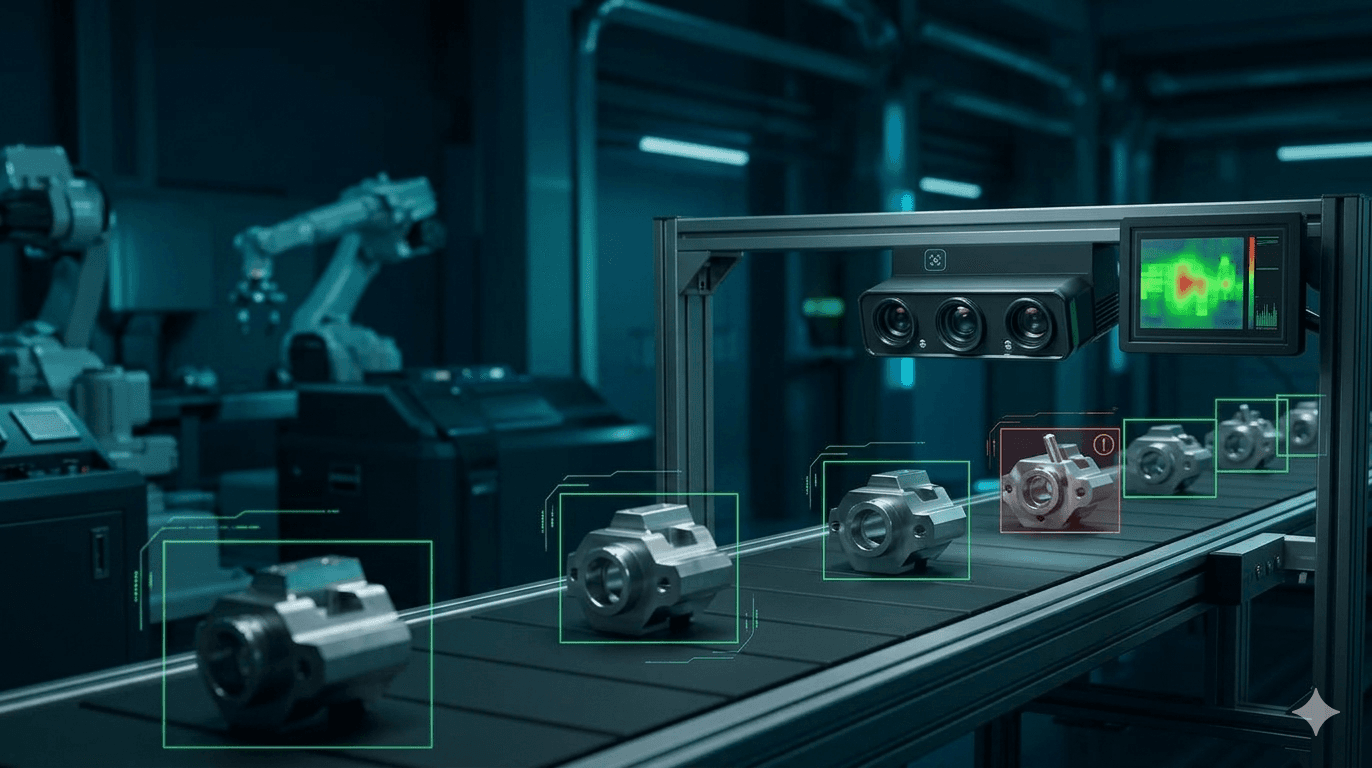
Rejects
Flagged
Flow
Active
Inspection objective
Reduce missed defects and unstable review decisions on the line
What it means in practice
Automated visual inspection is an operational tool, not just a model
Teams searching for automated visual inspection systems usually need one thing: a more reliable way to inspect products in real line conditions. That means cameras, software, decision logic, and review workflow all need to work together.
Automate repetitive visual checks
Automated visual inspection means using cameras and software to perform consistent checks on products, packs, components, or line events without relying only on manual attention.
Turn images into inspection decisions
The goal is not image analysis for its own sake. The goal is to classify defects, verify presence, flag uncertain cases, and support production workflows with usable inspection signals.
Fit the line, not just the model
A strong automated visual inspection system has to match line speed, product variation, lighting conditions, review workflows, and what teams actually need to decide.
Support better quality control
In practice, visual inspection automation helps quality teams reduce missed defects, reduce false rejects, and make review effort more targeted and consistent.
Common inspection problems
Real lines create inspection problems that are specific and measurable
Automated visual inspection for manufacturing becomes relevant when manual review no longer scales, legacy vision becomes unstable, or quality teams need better visibility into what is actually happening.
Manual inspection does not stay consistent
Even strong teams cannot inspect every product with the same consistency across long shifts, fast lines, repeated tasks, and changing product formats.
Missed defects still reach downstream steps
Surface issues, packaging errors, assembly problems, or fill inconsistencies are often caught late when inspection depends too heavily on human attention.
False rejects create hidden production cost
Inspection instability creates avoidable waste, line disruption, and more manual review when good units are flagged too often.
Variation breaks rigid setups
Format changes, SKU variation, orientation shifts, and lighting changes make many rule-based inspection approaches unstable over time.
Review effort stays too high
When too many cases are uncertain, teams still spend time reviewing images manually instead of resolving the inspection bottleneck.
Line visibility remains limited
Many teams still lack immediate feedback on what is being rejected, what defect types are recurring, and where the process is drifting.
What can be inspected
The strongest automated visual inspection use cases are concrete
Surface and appearance defects
Detect scratches, cracks, contamination, dents, deformations, or unusual surface presentation.
Presence and completeness checks
Verify whether expected components, inserts, labels, caps, or pack elements are present and correctly positioned.
Packaging inspection
Support label inspection, seal inspection, print checks, packaging conformity, and pack composition verification.
Fill level and visible quantity checks
Detect visible underfill, overfill, or inconsistent product presentation where fill conditions matter to quality.
Assembly verification
Confirm parts, orientation, completion, and visible assembly conditions before units move downstream.
Counting and tracking
Use visual inspection automation to confirm counts, product flow, and unit presence through production or packaging steps.
Where it works best
Automated visual inspection works best when the use case is tied to real line behavior
Traditional limitations
Why manual inspection and rigid systems struggle over time
Business value
Operational outcomes that matter to quality and production teams
How a project starts
Start narrow, assess feasibility, and validate before scaling
01
Define the inspection challenge
Start with a specific production problem, defect category, or review bottleneck rather than a broad transformation project.
02
Review line conditions and feasibility
Assess cameras, lighting, product variation, defect visibility, line speed, and what the operation needs the inspection output to do.
03
Run a focused pilot
Validate a narrow automated visual inspection use case before committing to wider rollout decisions.
04
Move toward production deployment
If the pilot is validated, expand into a production workflow with the right review logic, ownership, and operational integration.
Related pages
Explore adjacent topics in the automated visual inspection cluster
Automated Visual Inspection Systems
For buyers comparing system-level solutions, workflow integration, and deployment requirements.
Automated Visual Inspection for Manufacturing
For operations and engineering teams focused on line performance, part checks, and production constraints.
Automated Visual Inspection for Pharma
For pharmaceutical and medical packaging environments where label, code, and fill checks require careful feasibility review.
Packaging Inspection with Computer Vision
For packaging lines dealing with seals, labels, fill level, and packaging conformity issues.
FAQ
Practical questions about automated visual inspection
What is automated visual inspection in manufacturing?
It is the use of cameras and software to automate visual checks on products, packaging, assemblies, or line conditions. In manufacturing, it is used to detect defects, verify presence, reduce manual review burden, and improve inspection consistency.
What can automated visual inspection software check?
Common examples include surface defects, label issues, seal checks, fill level inspection, part presence, assembly verification, packaging conformity, and count or presence verification. The right fit depends on the line and the defect categories that matter most.
Is automated visual inspection only useful for large manufacturers?
No. Larger manufacturers often have more inspection complexity, but smaller operations can also benefit when a visual inspection problem is repetitive, measurable, and important enough to justify a focused pilot.
How do you assess feasibility for automated visual inspection?
Feasibility depends on product variation, line speed, image conditions, defect visibility, acceptable decision logic, and how the output will be used by quality or operations teams.
Why do traditional visual inspection systems become unstable?
They often rely on fixed rules, narrow thresholds, or highly controlled conditions. As lighting, formats, materials, or line presentation changes, performance can become unstable and manual review starts growing again.
Can automated visual inspection start with a pilot?
Yes. A focused pilot is usually the best starting point because it allows teams to test operational fit, inspection performance, and review workflow before scaling the project.
Want to review an automated visual inspection use case?
Discuss a defect category, a false reject problem, a manual review bottleneck, or a focused pilot where automated visual inspection could improve production decisions.